Quadrennieial Eneegy Review April 2015 Figure 3-1 Electric Grid
Though disquisitional to the nation's power grid, large ability transformers are some of the most vulnerable components in the system. Armed with a shared determination for resiliency, authorities, manufacture, grid owners, and academia are collaborating on every front—policy, technology, and business—to ensure that if disaster strikes, the grid will persevere.
If very casually, the Due north American electric functioning and delivery system—collectively referred to as the grid—is compared to a human trunk, its 6,000 power plants serve disquisitional digestive and pulmonary functions to convert fuel into energy and release it into the bloodstream. Large power transformers (LPTs) perform the significant cardiac part of stepping upwardly voltage for efficient long-haul transmission over roughly 360,000 miles of lines until information technology is stepped downwardly again for distribution suitable for end use. But, though so crucial to the bulk power system, LPTs—which a N American Reliability Corp. (NERC) definition limits to generation step-up (GSU) transformers on the high-voltage side (100 kV or higher, with a nameplate rating of at least 75 MVA) and transmission transformers on the low-voltage side (100 kV or college, with a nameplate rating of at least 100 MVA)—are under a constant avalanche of threats, both natural and manmade.
A number of entities take increasingly warned that forth with celebrated weather condition events such as lightning strikes, tornadoes, derechos, and tropical storms, sure high-impact, depression-frequency events, similar severe geomagnetic disturbances (GMDs) or electromagnetic pulses (EMPs)—although rare—could harm multiple transformers, causing a cascading result on the organization (see sidebar). Physical threats are too ever-present. In Apr 2013, attackers incapacitated a number of power transformers at the Metcalf manual substation in California using loftier-powered rifles. While a coma was avoided through power redispatch, the incident caused more than than $xv million in physical damages that took well-nigh a month to repair.
GMD and EMP Threats: Overblown?
While government entities in the U.South. and Canada along with industry organizations have widely studied general threats posed to the grid from a severe geomagnetic disturbance (GMD) resulting from a solar tempest, and to a lesser extent, threats posed by a high-distance electromagnetic pulse (HEMP) resulting from the detonation of a nuclear device, consensus is that more than research is needed to inform assessments for specific mitigation measures by generators and transmission providers. Nigh studies, however, agree that the vulnerable components with the greatest potential effect in the issue of loss are big power transformers (LPTs).
Depending on the blueprint of a transformer and the magnitude and duration of a GMD event, geomagnetically induced currents (GIC) could cause rut damage to the condition, performance, and insulation life of a transformer. However, studies offering mixed assessments of how widespread damage could be. The North American Reliability Corp. and the Department of Energy in June 2010 warned that while the failure of a large number of LPTs during a astringent GMD event was unlikely, certain older generator pace-up (GSU) transformers could be particularly susceptible to breakup.
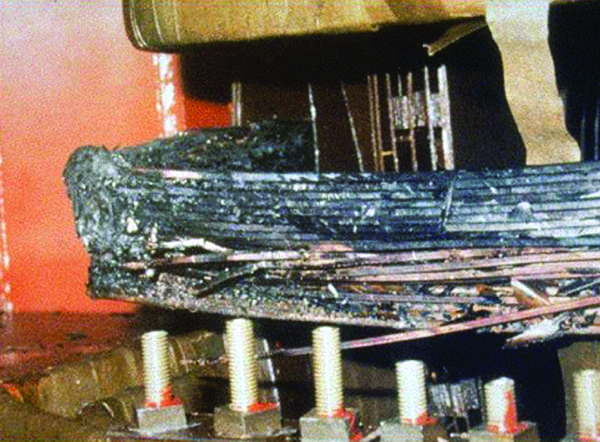 |
| ii. Scorched by the storm. A March 1989 solar storm resulted in the complete loss of a 1,000-MVA generator step-up (GSU) transformer continued to the 500-kV transmission grid at the Salem Nuclear Establish in New Jersey. This image shows the extensive internal harm that occurred to the 22-kV low-voltage windings in the transformer. One skilful suggested that within two years after the tempest, 11 nuclear plants recorded failures of GSU transformers that were likely linked to the upshot. Courtesy: Metatech Corp. |
Such furnishings were apparent during the March 1989 geomagnetic storm, which resulted in a collapse of Hydro-Quebec's organization, leaving six 1000000 people without power for nine hours. The upshot also resulted in damage from hotspot heating to a GSU at Salem Nuclear Power Plant in New Jersey (Effigy ii). A moderate intensity storm on April 3, 1994, meanwhile, resulted in the catastrophic failure of a GSU transformer at Zion Nuclear Constitute and was likely responsible for GSU failures at Braidwood nuclear plant and Powerton coal plant within weeks of the event, an skilful from electromagnetic environmental solutions house Metatech Corp. said.
A HEMP upshot, too, could interrupt service. But according to the Electric Power Enquiry Institute (EPRI) the effects of an E3 event—the equivalent of a i.4 megaton flop detonated 250 miles above the earth (100 times more than the nuclear bomb dropped on Hiroshima)—would exist limited to a regional level. Every bit part of an ongoing three-year study to investigate HEMPs, EPRI ended in February 2017 that though hundreds to thousands of transformers could experience GIC flows of greater than 75 amps/phase during an E3 event, but virtually iii to 14, depending on the target location, could be at potential risk of thermal damage. The written report too concluded that dissentious levels of 3rd winding heating, resulting from the menstruation of harmonic currents generated past the resulting GIC flows, are unlikely to occur.
Despite these findings, some generators and manual owners are making changes to guard against GMDs and HEMPs. A number are replacing older transformers, opting for models that are more resilient to the effects of GIC. Others accept added GIC-blocking series capacitors to their networks to enhance network efficiency and help stability and voltage regulation. Some have likewise moved to replace older electro-mechanical protective relays used in their grid command systems with newer digital relays that tin exist programmed to properly reply to weather. Other measures include building hardened command centers, and installing loftier-frequency filters, grounding, and surge protection devices to guard against pulses.
Meanwhile, as an added, significant complication, the boilerplate age of installed LPTs in the U.S. was about 40 years in 2011—when about seventy% of LPTs were more than 25 years old. The life expectancy of an LPT depends on how it is used, but clearly, "crumbling power transformers are subject to an increased risk of failure," the Section of Energy (DOE) has warned. Industry, on the other manus, notes that GSU transformers are at a heightened risk of failure attributable to a pass up in available technical expertise, along with wearable-and-tear as plant functions transform and more baseload plants are forced to operate in peaking fashion.
A Vulnerable Eye
For NERC, which is working to ramp up measures to improve resiliency and recovery of the bulk power system, and guard against these and other threats, LPTs pose specific vulnerabilities.
LPTs are typically mammoth pieces of equipment weighing as much as 410 tons. Considering they are tailored to customer specifications and crave intricate procurement and manufacturing processes, lead times for obtaining an LPT often range betwixt five and sixteen months, but could stretch across 20 months to make them, according to a 2014 DOE estimate. They're likewise ordinarily non interchangeable, and worse, they aren't typically produced for extensive spare inventories.
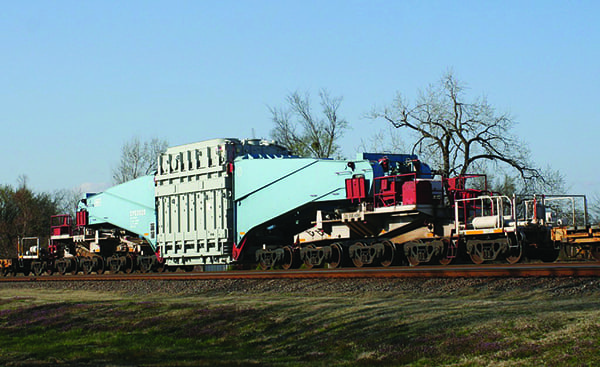 |
| i. Heavy load. Because large power transformers tin be so large, runway transport is most common, but they need specialized freight carriers and special permits and routes. Simply 30 Schnabel railroad freight cars were available in Northward America in 2012. This image shows transportation of a Consumers Ability transformer via Schnabel auto in 2008. Source: Quatro Valvole/Wikimedia Commons |
And they are costly. In 2017, an unnamed transformer maker told the Government Accountability Function that an LPT weighing betwixt 170 and 410 tons could cost between $2 million and $seven.v million in the U.South.—and that probable did not account for costs of raw materials, which include substantial amounts of copper and steel, bolt that are increasingly stricken past price volatility owing to high demand in global markets. Nor does information technology business relationship for transportation, which requires special modes, such as a specialized Schnabel railroad freight car (Figure 1). The DOE estimated that raw materials, transportation, installation, and other expenses could add another 25% to xxx% to the price tag.
As critically, co-ordinate to the DOE, though the U.S. has seen a growing demand for LPTs since the 1990s, it has historically suffered a express domestic capacity to produce them. Since 2010, four new or expanded facilities have begun producing LPTs, including SPX Transformer Solutions' facility in Wisconsin and Hyundai Heavy Industries' facility in Alabama. Until at to the lowest degree 2013, 88% of imported LPTs came from seven countries—the bulk of which arrived from South korea. However, that country is now embroiled in an LPT merchandise dispute with the U.S., announcing in Feb that it would challenge the Trump administration's 61% anti-dumping duty slapped on Korean-fabricated LPTs in March 2017.
Industry and Government: A Heartfelt Collaboration
The risks to reliability associated with the loss of 1 or more LPTs are so worrisome that nearly every stakeholder has jumped into action. The DOE recommended in its Apr 2015 Quadrennial Energy Review that the agency analyze the technical specifications of a potential transformer reserve and assess existing industry equipment sharing efforts as part of a broader initiative. Congress backed the mensurate in Dec 2015 with passage of the Fixing America's Surface Transportation (FAST) Act, and the DOE is actively engaging with industry, transformer manufacturers, and other federal agencies on how to resolve the risks.
In a March 2017 report to Congress, while the DOE described the national importance of a strategic transformer reserve, information technology recommended that such a reserve be an industry-based option driven by voluntary industry actions and requirements under NERC'south critical infrastructure protection CIP-014-2 standard. Beginning in March 2018, the DOE will reassess whether that approach has made sufficient progress, and if it has not, whether the authorities should take action.
For now, resiliency gaps apropos transmission LPTs, at least, appear bridged. Citing a technical analysis led past Oak Ridge National Laboratory (ORNL), the DOE highlighted in its report to Congress that a number of spare LPTs are available to supplant those contained in crucial substations on the grid operating at each interconnection's highest voltage levels (765 kV and 500 kV in Eastern, 500 kV in Western, and 345 kV in Texas). The ORNL study, information technology noted, was based in part on a 2016 survey conducted by the Edison Electrical Institute—the trade grouping representing all U.S. investor-owned utilities—the American Public Power Association, and the National Rural Electricity Cooperative Association of their members to decide how many spare transmission LPTs were available.
Individual utilities ORNL interviewed reported they are implemented a spare transformer strategy that includes stocking interchangeable spare transformers or ordering an extra inventory of conventional spares, or they are retiring transformers early to brand spares available one time new equipment is installed. Across the industry, efforts by several consortia and companies are underway to ensure adequate sharing of transformers and other equipment in the event of major grid disruptions (run across sidebar).
Industry Leads Transformer Sharing Efforts
Spare Transformer Equipment Program (Step). EEI's STEP involves a bounden contract that requires participating electrical utilities—nigh 56 which had signed on as of March 2016—to maintain (and sometimes to acquire) a specific number of transformers of upward to 500 kV and share them in the event of a coordinated human action of deliberate, documented terrorism that destroys a transmission substation, and the President declares a state of emergency. To participate in STEP, participating utilities pay enrollment fees of $10,000 and almanac dues of $7,500, funds that are typically recovered in rates.
SpareConnect. This less formal voluntary mutual aid initiative spearheaded by EEI builds on existing communication channels to allow them to meet technical needs during an emergency or non-routine failure not continued to terrorism.
Grid Balls. The goal of this company, formed in 2016 by six power companies in 2016—Edison International, Berkshire Hathaway, Great Plains Energy, American Electric Power, Duke Energy, and Eversource Free energy—and which became fully functional in Jan 2018, is to provide physical equipment, manpower, and logistics during disasters. Transmission owners subscribing to the service have access to inventory pools of at to the lowest degree 100 transformers that cost between $2 million and $10 million, storage, and transportation back up. FERC in March 2016 backed the initiative, ruling that subscribers would not have to pursue total charge per unit cases to recover costs simply could instead employ single-upshot ratemaking. "Nosotros have transmission owners as subscribers and plan to place an equipment order after this year," Michael Deggendorf, CEO of Grid Assurance, told Ability in March. "Electric current and potential subscribers tell us step-upwards transformers are an option they would similar included in their resiliency efforts, and so we are looking at adding step-upwardly transformers to our solution."
Wattstock. Another private company, Wattstock maintains a member-based national transformer inventory plan for spare coverage located at regional distribution centers that can be shipped within weeks of an emergency event. The inventory includes nine generator step-upward transformer models, which represent 97% of the traditional MVAs in the market, five transmission models, and WattStock Flex Transformers for quick delivery and piece of cake installation.
RESTORE (Regional Equipment Sharing for Transmission Outage Restoratation). In November 2016, Southern Co., Louisville Gas and Electric Co., Kentucky Utilities Co., PPL Electric Utilities, and the Tennessee Valley Authority launched a regionally focused voluntary transformer-sharing initiative.
Spare Equipment Database (SED). This NERC-developed initiative is a voluntary program that facilitates sharing of both transmission and generator step-up transformers.
Grid operator initiatives. At a regional level, meanwhile, grid operators are pushing wholesale market place participants to maintain spare transformer inventories or at least take spare equipment on hand. PJM, for case, has a regional manual expansion plan that requires owners and operators to procure a certain number of spare transformers based on a risk assessment. The Midcontinent Independent System Operator, meanwhile, requires owners and operators to provide descriptions of spare inventories, and the California Independent Organisation Operator requests emergency operating plans and resource for responding to major events.
However, the DOE noted in its report to Congress, major shortcomings still be that could require federal intervention. Industry has urged the regime to play a larger role in transporting spare LPTs, peculiarly in emergency weather condition. Industry has attempted to resolve the problem on its own, establishing in 2014 the Transformer Transportation Working Group at the request of the Electricity Subsector Coordinating Quango. That group of 70 industry executives has been working to speed up LPT transportation, developing an emergency support guide with railroads, the heavy hauler manufacture, federal agencies, and the National Baby-sit. Industry stakeholders also underscored that critical equipment and personnel are needed for adequate storage and installation of replacement LPTs, forth with critical components like bushings and circuit breakers.
Every bit critically, the study noted that a famine of information exists for GSUs. While these components share manufacturing supply bondage, material requirements, and transportation resources requirements, generating station vulnerabilities differed from those of network substations, the DOE noted. "More information will be needed to appraise the demand for additional spare GSUs, including their specific characteristics and vulnerability profiles of crucial ability generating stations, comparative lead times to replace GSUs, and the availability of spare GSUs."
Technology Is Transforming the Transformer
In the backdrop, industry is as well developing a new generation of transformers that will address resiliency concerns. Armed with funding from the DOE'due south Transformer Resilience and Advanced Components program, a handful of designs are making headway to increase sharing and advance recovery.
A Modular Controllable Transformer. Georgia Tech Research Corp., ORNL, Delta Star, and Southern Co. have teamed to design a modular controllable transformer that can be paralleled as needed to realize power ratings in the range of 100 MVA to 500 MVA. The transformer could support grid operations under single or multiple transformer failures, providing flexibility in configuration, load balancing, transportation, and faster restoration.
High-Frequency Link Transformer. NextWatt, the National Center for Reliable Electric Power at the University of Arkansas, and Full general Electric (GE) are developing a design for a solid-state, modular high-frequency link LPT rated at 100 MVA with a high-side voltage of 115 kV, variable depression-side voltage, and variable impedance capability. Co-ordinate to the DOE, the concept is targeting an average cost of $15–$22/kVA, lifetime of more than than xl years, and an efficiency of at least 99%, which is comparable to current LPTs. Among the concept'southward notable characteristics is that it could exist a third the size and weight of a conventional LPT, easing transportation concerns.
Grid-Ready Flexible LPT. GE is besides developing a separate flexible LPT capable of accommodating multiple standard voltage ratios in the transmission network also as providing an adjustable impedance to friction match that of a failed transformer to exist replaced. A three-stage LPT is proposed with power chapters ranging from 300 to 600 MVA, high-side voltage of 345 kV with configurable taps at the low-voltage side for functioning at 115 kV, 138 kV, and 161 kV, and adjustable impedance from 4% to 12%. "The key innovations in this project include multiple transmission class voltage taps at the low-voltage side; a method for selecting the transformer impedance without changing the voltage ratio; and arrangement and connectedness of all the extra windings to minimize stresses," the DOE noted.
Novel Flexible and Resilient LPT. Zurich-headquartered ABB, a global transformer supplier and innovator, and The University of Tennessee, Knoxville are investigating a design for an LPT comprised of easily transportable, standardized building blocks, which house several transformer modules. During the project, various pattern possibilities and system architectures volition be explored to enable high-side voltages ranging from 115 kV to 500 kV, low-side voltages ranging from 69 kV to 230 kV, and power levels upwardly to 500 MVA.
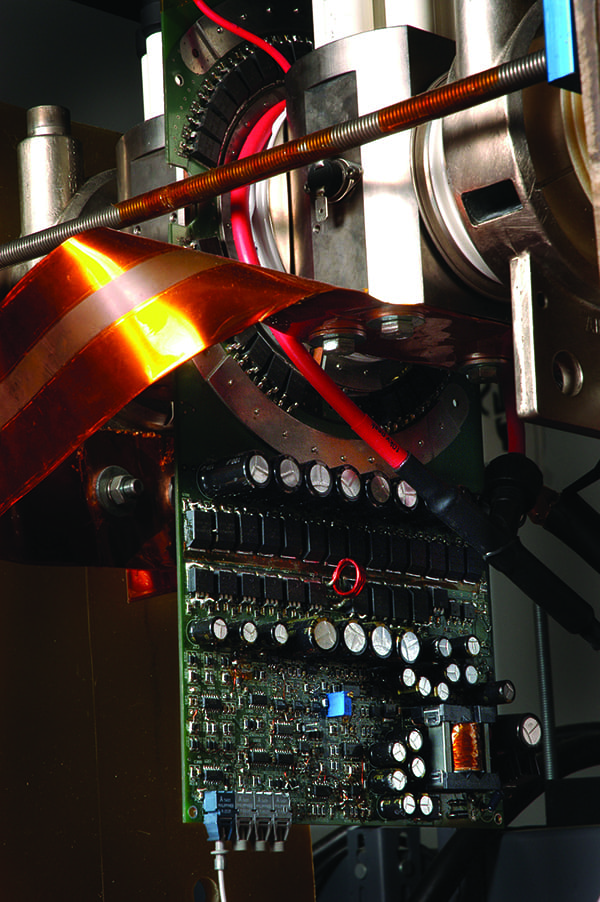 |
| 3. A solid transformation. For a decade now, N Carolina State University's FREEDM Systems Center has explored how solid-state transformers (SST)—essentially a collection of loftier-powered semiconductor components, conventional high-frequency transformers, and control circuitry—tin provide flexibility to the filigree. Courtesy: Northward Carolina State University |
Flexible Solid-State LPT. Due north Carolina State University and Carnegie Mellon University are also developing a Flexible Big Power Solid State Transformer (Figure 3), a modular solution where flexible voltage ratings will exist achieved by series/parallel connection of a basic edifice block (five MVA). The blocks volition comprise a power electronics-based medium-frequency transformer to achieve voltage isolation and variable step-upwards and step-down voltage ratios. "The employ of standard building blocks can reduce manufacturing and inventory cost and enable greater interchangeability," the DOE said.
Recovery Transformer (RecX). The Section of Homeland Security (DHS) Science and Engineering science Advisers (S&T) and the Office of Infrastructure Protection partnered with EPRI, CenterPoint Energy, and ABB to develop a 60-ton rapidly deployable actress-loftier-voltage transformer design that it successfully demonstrated for one year ending in March 2013 in Houston (Effigy 4). According to the DHS, the three 345-kV/138-kV transformer prototypes were installed and energized in less than six days (106 hours), which included a 25-hour road journey from a temporary storage site at the ABB factory in St. Louis, Missouri, where they were designed and manufactured. The RecX transformers reached meridian load of 330 MVA on August ix, 2013, which is approximately 55% of their 600 MVA design capacity. However, while RecX was deemed a suitable replacement for more than than 90% of 345-kV to 138-kV transformers, no additional units have been sold or larger models manufactured.
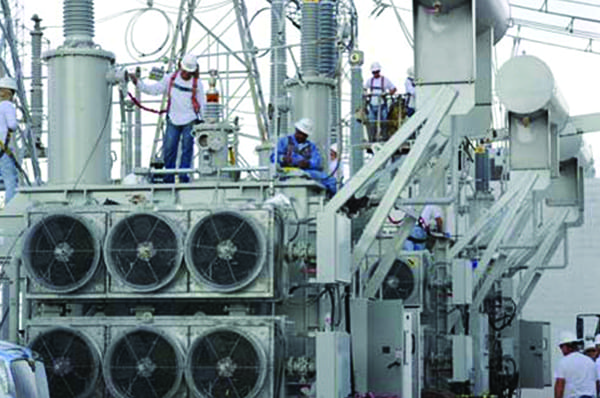 |
| 4. A resilient prototype. Three single-stage extra-high-voltage transformer prototypes adult with backing from the Section of Homeland Security under the Recovery Transformer (RecX) project were field tested from 2012 to 2013 at a CenterPoint substation near Houston, where they continue to operate. The field test demonstrated RecX's rapid deployment speed. Information technology was transported, installed, and energized in less than six days. Source: DHS/Paul Wedig |
In a report describing lessons learned from the RecX project, EPRI and the DHS lauded recent engineering science achievements and industry efforts to facilitate LPT sharing, but they noted a long-term strategy is needed. Ane recommendation they offered is that as stakeholders assess new transformers to supplant the aging ones now in service, stakeholders should exploit the opportunity to adopt a "more broadly applicable transformer design" with rapid deployment characteristics to brand replacements and spares easier to access and install.
To realize that vision, original equipment manufacturers (OEMs) would demand to move toward design and manufacture of such a transformer for conventional use and for spares, giving industry "a better product" for its pressing needs. Regional filigree operators and industry would likewise need to work closely with OEMs to ascertain these designs, "with an eye towards migrating these blueprint features into 'conventional' transformers that are installed every bit existing units are retired; and ultimately standardizing these designs start within utility service territories, and then within regions where possible," the report says.
This may sound far-fetched, but all stakeholders have plainly come together to baby-sit against disasters affecting their common grid, and then perhaps a shared conclusion for resiliency will evolve into the heart of the matter. ■
—Sonal Patel is a POWER associate editor.
Source: https://www.powermag.com/disaster-preparedness-the-quest-for-transformer-resilience/
0 Response to "Quadrennieial Eneegy Review April 2015 Figure 3-1 Electric Grid"
Post a Comment