To an Event in What Text Has Kumarbi Biting Off Anus Genitals Been Compared?

| Fertile Crescent myth series | |
|---|---|
| | |
| Mesopotamian | |
| Levantine | |
| Arabian | |
| Near Eastern Religions | |
| The Levant | |
|
|

Atargatis (; Aboriginal Greek: Ἀτάργατις, romanized: Atárgatis or Aramaic: 𐡀𐡕𐡓𐡀𐡕𐡄, romanized: ʿtrʿth ) was the master goddess of northern Syria in Classical artifact.[1] [two] Ctesias also used the proper noun Derketo (Ancient Greek: Δερκετὼ) for her,[three] and the Romans called her Dea Syrian arab republic, or in one discussion Deasura.[iv] Primarily she was a goddess of fertility, simply, equally the baalat ("mistress") of her city and people she was also responsible for their protection and well-beingness. Her primary sanctuary was at Hierapolis, modern Manbij,[5] northeast of Aleppo, Syria.
Michael Rostovtzeff chosen her "the great mistress of the North Syrian lands".[2] Her consort is commonly Hadad. Every bit Ataratheh, doves and fish were considered sacred to her: doves equally an emblem of the Love-Goddess, and fish as symbolic of the fertility and life of the waters.[6]
According to a third-century Syriac source, "In Syria and in Urhâi [Edessa] the men used to castrate themselves in honour of Taratha. But when King Abgar became a believer, he allowable that anyone who emasculated himself should accept a paw cut off. And from that day to the present no one in Urhâi emasculates himself anymore."[seven]
She is sometimes described every bit a mermaid-goddess, due to identification of her with a fish-bodied goddess at Ascalon. Even so, there is no evidence that Atargatis was worshipped at Ascalon, and all iconographic evidence shows her every bit anthropomorphic.[8]
Origin and name [edit]
Atargatis is seen as a continuation of Bronze Age goddesses. At Ugarit, cuneiform tablets attest multiple Canaanite goddesses, amongst them 3 are considered as relevant to theories well-nigh the origin of Atargatis:
- ʾAṭirat, described as "Lady of the Sea" (rabbatu ʾat̪iratu yammi) and "mother of the gods"
- ʿAnat, a war goddess
- ʿAțtart, a goddess of the hunt also sharing Anat'southward warlike office, regarded equally analogous to Ishtar and Ishara in Ugaritic god lists and as such possibly connected to beloved
John Day asserts that all three shared many traits with each other and may have been worshipped in conjunction or separately during 1500 years of cultural history.[9] While the worship of Ashtart and Anat as a pair is well attested,[10] [11] Steve A. Wiggins plant no prove Ashtart was always conflated with Athirat.[12] He also pointed out that the concept of Athirat, Anat and Ashtart equally a trinity of sorts (popularized past authors similar Tikva Frymer-Kensky), is modern and ignores the part of other deities in Ugarit - for example Shapash; as well every bit the importance of the connection between Athirat and El.[thirteen] [14]
The proper name Atargatis derives from the Aramaic grade ʿtrʿth , which comes in several variants. At Hierapolis Bambyce (modern solar day Manbij) on coins of about the 4th century BCE, the legend ʿtrʿth appears, for ʿAtarʿate, and ʿtrʿth mnbgyb in a Nabataean inscription; at Kafr Yassif near Akko an altar is inscribed "to Adado and Atargatis, the gods who mind to prayer";[15] and the total name ʿtrʿth appears on a bilingual inscription institute in Palmyra.
Robert A. Oden assumes that the name of Atargatis was a compound of Astarte's and Anat's.[sixteen] The name ʿAtarʿatheh is widely held to derive from a compound of the Aramaic course ʿAttar, which is a cognate of ʿAțtart minus its feminine suffix -t, plus ʿAttah or ʿAtā, a cognate of ʿAnat.[17] [18] Alternatively, the 2nd half may be a Palmyrene divine proper noun ʿAthe (i.e. tempus opportunum), which occurs every bit role of many compounds.[xix] It has too been proposed that the chemical element -gatis may relate to the Greek gados "fish".[20] (For example, the Greek name for "body of water monster" or "whale" is the cognate term ketos). So Atar-Gatis may merely mean "the fish-goddess Atar".
Cult centers and images [edit]
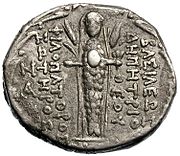

As a consequence of the showtime half of the name, Atargatis has oftentimes, though wrongly, been identified as Ashtart.[22] The two deities were probably of common origin and have many features in common, merely their cults are historically singled-out. At that place is reference in 2 Maccabees 12.26[23] and 1 Maccabees five:43[24] to an Atargateion or Atergateion, a temple of Atargatis, at Carnion in Gilead, but the home of the goddess was unquestionably not Israel or Canaan, merely Syrian arab republic itself; at Hierapolis Bambyce she had a temple in her name.[19] At Palmyra she appears on the coinage with a lion, or her presence is signalled with a king of beasts and the crescent moon; an inscription mentions her. In the temples of Atargatis at Palmyra and at Dura-Europos[25] she appeared repeatedly with her espoused, Hadad, and in the richly syncretic religious culture at Dura-Europos, was worshipped equally Artemis Azzanathkona.[26] Two well preserved temples in Niha, Lebanese republic are defended to her and to Hadad. In the 1930s, numerous Nabatean bas-relief busts of Atargatis were identified by Nelson Glueck at Khirbet et-Tannûr, Jordan, in temple ruins of the early outset century CE;[27] there the lightly veiled goddess'southward lips and eyes had one time been painted ruby, and a pair of fish confronted one another above her head. Her wavy hair, suggesting water to Glueck, was parted in the middle. At Petra the goddess from the north was syncretised with a Northward Arabian goddess from the due south al-Uzzah, worshipped in the ane temple. At Dura-Europus among the attributes of Atargatis are the spindle and the sceptre or fish-spear.[28]
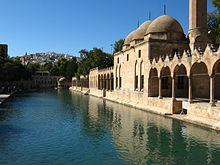
The fishpond of fish sacred to Atargatis survives at Şanlıurfa, the ancient Edessa, its mythology transferred to Ibrahim.
At her temples at Ascalon, Hierapolis Bambyce, and Edessa, there were fish ponds containing fish only her priests might affect.[29] Glueck noted in 1936 that "to this day at that place is a sacred fish-pond swarming with untouchable fish at Qubbet el-Baeddwī, a dervish monastery three kilometres east of Tripolis, Lebanon."[xxx]
From Syria her worship extended to Greece and to the furthest West. Lucian[31] and Apuleius requite descriptions of the ragamuffin-priests who went round the great cities with an image of the goddess on an ass and collected money. The wide extension of the cult is attributable largely to Syrian merchants; thus we notice traces of it in the great seaport towns; at Delos especially numerous inscriptions have been found bearing witness to her importance. Again nosotros find the cult in Sicily, introduced, no dubiousness, by slaves and mercenary troops, who carried it even to the farthest northern limits of the Roman Empire.[19] The leader of the insubordinate slaves in the Kickoff Servile State of war, a Syrian named Eunus, claimed to receive visions of Atargatis, whom he identified with the Demeter of Enna.
Syncretism [edit]
In many cases Atargatis, 'Ashtart, and other goddesses who once had independent cults and mythologies became fused to such an extent as to be duplicate. This fusion is exemplified by the Carnion temple, which is probably identical with the famous temple of 'Ashtart at Ashtaroth-Karnaim. Atargatis more often than not appears as the married woman of Hadad. They are the protecting deities of the community. Atargatis, wearing a landscape crown, is the ancestor the royal firm, the founder of social and religious life, the goddess of generation and fertility (hence the prevalence of phallic emblems), and the inventor of useful appliances. Not unnaturally she is identified with the Greek Aphrodite. By the conjunction of these many functions, despite originating as a ocean deity analogous to Amphitrite, she becomes ultimately a great nature-goddess, analogous to Cybele and Rhea: In one attribute she typifies the protection of water in producing life; in another, the universal of other-earth;[32] in a 3rd (influenced, no doubt, by Chaldean star divination), the power of Destiny.[19] She was as well identified with Hera past Lucian in his De Dea Syria.[33]
Mythology [edit]
The legends are numerous and of an astrological character. A rationale for the Syrian pigeon-worship and abstinence from fish is seen in the story in Athenaeus 8.37, where Atargatis is naively explained to mean "without Gatis", the name of a queen who is said to have forbidden the eating of fish. Thus Diodorus Siculus (two.4.2), quoting Ctesias, tells how Derceto fell in dear with a youth and became by him the mother of a kid and how in shame Derceto flung herself into a lake near Ascalon and her body was changed into the form of a fish though her head remained man.[34] Derceto'due south child grew upward to become Semiramis, the Assyrian queen. In some other story, told by Hyginus, an egg brutal from the sky into the Euphrates, was rolled onto land by fish, doves settled on it and hatched it, and Venus, known as the Syrian goddess, came forth.[34]

The author of Catasterismi explained the constellation of Piscis Austrinus as the parent of the two fish making up the constellation of Pisces; according to that business relationship, it was placed in the heavens in retention of Derceto's fall into the lake at Hierapolis Bambyce near the Euphrates in Syria, from which she was saved by a large fish — which again is intended to explicate the Syrian abstinence from fish.
Ovid in his Metamorphoses (5.331) relates that Venus took the form of a fish to hide from Typhon. In his Fasti (2.459-.474) Ovid instead relates how Dione, by whom Ovid intends Venus/Aphrodite, fleeing from Typhon with her child Cupid/Eros came to the river Euphrates in Syrian arab republic. Hearing the air current of a sudden rise and fearing that information technology was Typhon, the goddess begged assistance from the river nymphs and leapt into the river with her son. Two fish bore them up and were rewarded by beingness transformed into the constellation Pisces — and for that reason the Syrians volition eat no fish.
A contempo analysis of the cult of Atargatis is an essay by Per Bilde,[35] in which Atargatis appears in the context of other Hellenized Groovy Goddesses of the East.
Priesthood [edit]

Bosom of a priest of Atargatis, 3rd century AD, Capitoline Museums
During the Roman era, eunuch priests worshipped Atargatis, like to the Galli priests of Cybele. At the shrine in Hieropolis founded by Semiramis, eunuch priests served the paradigm of a fish-tailed adult female. Rituals to the goddess were accompanied by flute playing and rattle shaking. In one rite, young males castrated themselves to go cross-dressing priests at the temple and thereafter performed tasks ordinarily done past women. The obligatory lake or pond lay nearby, full of sacred fish which no ane was allowed to eat; nor could anyone eat Atargatis'southward sacred doves.[36] The priests were described by Apuleius as mendicants that traveled around with an image of the goddess dressed in a silken robe on the back of a ass. When they arrived at village squares or a receptive manor they would perform an ecstatic rite, designed to attract a oversupply and elicit their contributions. The priests were described as effeminate, wearing heavy makeup, turbans on their heads, and dressed in saffron colored robes of silk and linen; some in white tunics painted with purple stripes. They shouted and danced wildly to the music of flutes, whirling around with necks bent so that their long hair flew out; and in an ecstatic frenzy they would seize with teeth their own mankind and cut their arms with knives until they bled.[37]
According to a story retold past Lucian, the Assyrian queen Stratonice saw in a vision that she must build a temple at Hieropolis to the goddess then the rex sent her in that location with a swain named Combabus to execute the task. Knowing the queen's reputation Combabus castrated himself and left his genitals, sealed in a box. When the queen fell in honey with Combabus and tried to seduce him, he revealed his mutilation, but this didn't dissuade her from desiring his constant companionship. When Stratonice and Combabus returned home, she defendant him of trying to seduce her, and Combabus was arrested, tried, and sentenced to death. Combabus called for the sealed box to prove his innocence, where upon the rex relented and rewarded Combabus for his loyalty. The temple was completed and a statue of Combabus was placed in it. This is said to be the origin of the practice of castration by the priests in the temple.
Another story ascribed to Combabus mentions that a certain strange adult female who had joined a sacred associates, beholding a human form of extreme dazzler and dressed in man's attire, became violently enamoured of him: after discovering that he was a eunuch, she committed suicide. Combabus accordingly in despair at his incapacity for love, donned woman's attire, then that no adult female in time to come might be deceived in the same mode.[38]
Notes [edit]
- ^ "Atargatis (Syrian deity) - Encyclopædia Britannica". Britannica.com. 2013-08-13. Retrieved 2014-08-11 .
- ^ a b One thousand. Rostovtseff, "Hadad and Atargatis at Palmyra", American Journal of Archaeology 37 (January 1933), pp 58-63, examining Palmyrene stamped tesserae.
- ^ Strabo, Geography, Book 16, iv.27; Piny, Natural History 5.81.
- ^ Lucian, de Dea Syrian arab republic, which is the conventional Latin title of his Ancient Greek: Περὶ τῆς Συρίης Θεοῦ; cf Chisholm, 1911.
- ^ "Hierapolis, at". Britannica.com. 2013-x-06. Retrieved 2014-08-11 .
- ^ "Atargatis, the Phoenician Groovy Goddess-Dea Syria Derketo Derceto mermaid goddess fish goddess water goddess canaanite goddess syrian goddess". Thaliatook.com. Retrieved 2014-08-xi .
- ^ Walter Bauer; Robert A. Kraft; Gerhard Krodel (1996). Orthodoxy and heresy in primeval Christianity. Sigler Press. p. 5. ISBN978-0-9623642-7-iii . Retrieved 17 June 2012.
- ^ Drijvers Dea Syria LIMC. The modernistic repertory of literary allusions to her is Paul Louis van Berg, Corpus Cultus Deae Syriae (C.C.D.South.): les sources littéraires, Part I: Répertoire des sources grecques et latines; Part 2: Études critiques des sources mythologiques grecques et latines (Leiden:Brill) 1973.
- ^ John Mean solar day (i Dec 2002). Yahweh and the Gods and Goddesses of Canaan. Continuum. pp. 143–. ISBN978-0-8264-6830-7.
- ^ K. Smith, 'Athtart in Late Bronze Age Syrian Texts [in:] D. T. Sugimoto (ed), Transformation of a Goddess. Ishtar – Astarte – Aphrodite, 2014, p. 49-51
- ^ G. Del Olmo Lete, KTU 1.107: A miscellany of incantations against snakebite [in] O. Loretz, S. Ribichini, W. G. E. Watson, J. Á. Zamora (eds), Ritual, Faith and Reason. Studies in the Ancient Earth in Award of Paolo Xella, 2013, p. 198
- ^ South. A. Wiggins, A Reassessment of Asherah: With Further Considerations of the Goddess, 2007, p. 57, footnote 124; see also p. 169
- ^ S. A. Wiggins, A Reassessment of Tikva Frymer-Kensky's Asherah [in:] R. H. Bael, S. Halloway, J. Scurlock, In the Wake of Tikva Frymer-Kensky, 2009, p. 174
- ^ Due south. A. Wiggins, Shapsh, Lamp of the Gods [in:] N. Wyatt (ed.), Ugarit, religion and culture: proceedings of the International Colloquium on Ugarit, Organized religion and Culture, Edinburgh, July 1994; essays presented in honour of Professor John C. L. Gibson, 1999, p. 327
- ^ These instances are noted in Karel van der Toorn, Bob Becking, Pieter Willem van der Horst, Lexicon of Deities and Demons in the Bible, (1995: s.v. "Hadad"); the name also appears in the Talmud ("Ab. Zarah" 11b, line 28) equally ʿtrʿth.
- ^ Robert A. Oden, Jr, "The Persistence of Canaanite Religion" The Biblical Archeologist 39.1 (March 1976, pp. 31–36) p. 34; "the proper noun of the Hellenistic and Roman goddess Atargatis was a compound of Astarte and Anat", JAB simply states in Piotr Bienkowski, Alan Ralph Millard, eds. Lexicon of the Ancient Well-nigh East, (2000: southward.v. "Anat").
- ^ William Foxwell Albright (1968). Yahweh and the Gods of Canaan: A Historical Analysis of Two Contrasting Faiths. Eisenbrauns. pp. 133–. ISBN978-0-931464-01-0.
- ^ Philo (of Byblos); Harold Westward. Attridge; Robert A. Oden (1981). The Phoenician history. Catholic Biblical Association of America. p. 94. ISBN978-0-915170-08-one.
- ^ a b c d One or more of the preceding sentences incorporates text from a publication now in the public domain:Chisholm, Hugh, ed. (1911). "Atargatis". Encyclopædia Britannica. Vol. 2 (11th ed.). Cambridge University Press. p. 823.
- ^ Henry George Liddell, Robert Scott, A Greek-English Lexicon, s.v. "Atargatis" (Perseus.org on-line text)
- ^ Hyginus, Fabula 197: "Into the Euphrates River an egg of wonderful size is said to have fallen, which the fish rolled to the banking concern. Doves sat on it, and when it was heated, information technology hatched out Venus, who was later on called the Syrian goddess. Since she excelled the residue in justice and uprightness, past a favour granted past Jove, the fish were put among the number of the stars, and because of this the Syrians do non consume fish or doves, considering them as gods".
- ^ Dirven's hypothesis that at Palmyra Atargatis was identical to Astarte, who functioned as the Gad of Palmyra, has been criticised past Ted Kaizer (The Religious Life of Palmyra 2002 :153f), who suggests that we "stick to the divine names really given by the worshippers" and follow the Palmyrene inscriptions, which distinguish between them.
- ^ "on-line text". Livius.org. 2006-12-08. Retrieved 2014-08-eleven .
- ^ Just referring to "the temple that was in Carnaim" (on-line text).
- ^ She is intended at Dura-Europos in the guise of the Tyche of Palmyra, accompanied by the panthera leo, in a fresco from the sanctuary of the Palmyrene gods, removed to the Yale Art Gallery.
- ^ Rostovtseff 1933:58-63; Dura-Europos 3.
- ^ Nelson Glueck, "A Newly Discovered Nabataean Temple of Atargatis and Hadad at Khirbet Et-Tannur, Transjordania" American Journal of Archeology 41.3 (July 1937), pp. 361-376.
- ^ Baur, Dura-Europos III, p. 115. For Pindar (6th Olympian Ode), the Greek sea-goddess Amphitrite is "goddess of the gold spindle".
- ^ Lucian, De Dea Syria; Diodorus Siculus Ii.four.2.
- ^ Glueck 1936: p. 374, notation 4
- ^ Lucian, De Dea Syrian arab republic.
- ^ Macrobius. Saturnalia, 1.23.
- ^ Harland, Philip (2009). Dynamics of Identity in the World of the Early Christians. Continuum Books. ISBN9780567111463 . Retrieved 24 January 2019.
- ^ a b Chisholm 1911.
- ^ Per Bilde: Organized religion and Religious Practice in the Seleucid Kingdom (in series "Studies in Hellenistic Civilisation") Aarhus Academy Press (1990).
- ^ Attridge and Oden 1976: 23, 37, 39, 55
- ^ Apuleius, The Aureate Donkey 8.26–28
- ^ Lucian, De Dea Syria 19–29

References [edit]
- Moshe Weinfeld, "Semiramis: her name and her origin." In: Mordechai Cogan/Israel Eph'al (ed.), Ah, Assyria...:Studies in Assyrian history and ancient Most Eastern historiography presented to Hayim Tadmor (serial Scripta Hierosolymitana 33), (Jerusalem 1991), 99-103.
External links [edit]
 | Wikimedia Commons has media related to Atargatis. |
- Atargatis by Abufares
- Jewish Encyclopedia: Derceto
- Britannica Online Encyclopædia: "Atargatis"
- Atargatis, the "Syrian Goddess" past Johanna Stuckey
- Lucian of Samosata, Apropos the Syrian Goddess (English translation & commentary)
Source: https://en.wikipedia.org/wiki/Atargatis
0 Response to "To an Event in What Text Has Kumarbi Biting Off Anus Genitals Been Compared?"
Post a Comment